 |
OpenSWMM Engine
6.0.0-alpha.4
Data-oriented, plugin-extensible SWMM Engine (6.0.0-alpha.4)
|
|
OpenSWMM Engine
6.0.0-alpha.4
Data-oriented, plugin-extensible SWMM Engine (6.0.0-alpha.4)
|
The built-in explicit CPU marcher advances conservative surface volumes, face transfers and, for FULL_SWE, cell momentum. The October 2026 review corrected conservation, source accounting and shoreline reconstruction, then reduced CPU work without weakening the accepted numerical checks. This chapter explains the retained strategy and how to assess it on a new model. The equations and spatial reconstruction are in Chapter 9: Two-Dimensional Overland Flow Analysis §9.5.10; option syntax is in CHAPTER 2 - Input File Reference.
The optimized path does not introduce a new input keyword or a different results-file format. Its performance depends on the momentum closure, wet fraction, species count, mesh, output cadence and thread count. The review measured the Apple ARM64 CPU implementation; GPU correctness and speed were not tested. Existing backend eligibility rules still apply. A CPU result is not evidence for an equivalent GPU implementation.
A water-only second-order setup can use:
This is an option fragment, not a complete model. Supply the mesh, initial/boundary conditions, forcing, duration and output settings needed by the physical problem. Keep the original storage closure and coupling physics when evaluating an optimization.
| Requested configuration | Actual route or restriction |
|---|---|
FULL_SWE, order 1 | Piecewise-constant Godunov route; local time tiers available |
FULL_SWE, order 2, water only | Limited surface/depth/velocity reconstruction and SSP-RK2; global one-tier stepping |
| Order 2 with multiple tiers | Tiers reduced to one with a diagnostic |
| Order 2 with active surface transport | Falls back to first order with a diagnostic; prior tier reduction is not undone |
| Active second-order RK2 with groundwater | Standalone CPU pollutant/MSX/age/water-temperature CLOSED_FORM/ENSLAVED/SIGMA with symmetric groundwater/surface reactions, authored wells and HEAD/FLOW edges; porous RK2 adds soil energy/conduction and chemical/age inventories under constant, time-series or held AIR thermal boundaries and sensible or latent soil ET; a fully covered COUPLED/GROUND_COLUMN finite-contact profile also supports RK2 heat, chemical/age contact and reactions with nonlinear radiation, sensible atmosphere and accepted surface latent cooling; copied surface/groundwater sources, runtime aquifer HEAD/FLOW edges and rain/quality/ET/paired infiltration and authored surface STAGE/FLOW, in-memory series/rating, normal-flow boundaries and copied overrides use bounded stages, shared expiry and component continuation, with accepted rain reports; managed standalone RK2 sessions preserve native weather/calendar state, pending batches, copied prescriptions and numerical, binary or combined mesh-HDF5 history; disjoint water-only or qualified native LEGACY pollutant networks also preserve their actual hydraulic/quality state; independent owned degree-day/UEB snow supports water delivery with native or cached weather, full point/ledger restart and all four output modes; zero transport rows, heat disabled, no soil contact or copied weather are required; further heat, wider network quality and shared RK2 network owners remain guarded (Hydrology §9.11) |
| Local inertial or diffusive momentum | Their own first-order face laws; order 2 does not enable MUSCL for these closures |
FULL_SWE with CFL above 0.5 | CFL reduced to 0.5 with a diagnostic |
For transport or groundwater with local timestepping, explicitly request order 1 and the intended tier count. Read initialization diagnostics and inspect run statistics (swmm_2d_get_run_stats): backend, momentum mode, tiers, internal steps, face evaluations and active-cell fraction. The statistics do not independently prove that reconstruction order 2 was used; check fallback diagnostics and the model's enabled features too. A model with zero active surface faces does not exercise wet-surface performance, even if its groundwater is active.
Native LEGACY network pollutants now support numerical/binary checkpoint continuation, including signed native loads, current/old concentrations, load statistics and pollutant balances. First-order matched conservative mesh/aquifer rows can share actual surface/node exchange; an independent RK2 mesh can retain the native network quality owner alongside its own integrator. Pollutant order, units, decay, defaults and per-element initial quality participate in model identity. This profile excludes catchments, LIDs, treatment expressions, native heat/age and multispecies reactions. Shared network RK2, ARD/LARD continuation and broader quality owners remain guarded.
Every optimization must preserve the following ordering and invariants.
A zero water flux is not necessarily a zero momentum contribution. Hydrostatic pressure corrections remain active on a blocked face when both cut face depths vanish. The bed/source terms, wet connectivity, positive face-depth polynomial and shoreline cell velocity described in Chapter 9: Two-Dimensional Overland Flow Analysis are part of the numerical method, not dispensable work to remove from a profile.
The 1D engine stores hydraulic volume in ft³ and flow in ft³/s for every project. The surface solver and its mass-balance API use geometric SI. Three conversion conventions coexist for compatibility:
| Quantity or boundary | ft³ to m³ factor | Source and purpose |
|---|---|---|
| Legacy project display volume and CMS flow | 0.02832 | core/UnitConversion.hpp, UCF(VOLUME) for SI and Qcf[CMS]; preserves SWMM5 reports and public getter conventions |
| Legacy SI weir calculation | 0.028317 | hydraulics/HydStructures.cpp, M3perFT3; preserves legacy weir arithmetic |
| Geometric 1D/2D exchange | 0.3048³ = 0.028316846592 | 2d/SurfaceRouter2D.cpp; used for native hydraulic volumes and flows crossing the surface interface |
Thus a CMS flow returned by swmm_node_get_lateral_inflow() must be multiplied by 0.3048³ / UCF(FLOW, options) before integration against the surface ledger. In CMS, directly integrating the display flow gives a factor of 0.02832 / 0.3048³ = 1.0001113615525568 relative to geometric SI, a difference of approximately 0.011%. Convert native 1D routing totals from ft³ with 0.3048³ for that comparison; report display volumes use the legacy factor instead. This convention is preserved by design.
Exchange is staggered. The surface ledger books a transfer when the surface gives up or receives water; assembleLateralInflows() delivers the corresponding signed native volume to the network on later routing steps. At the observation time, pending transfer is sum(nodes.coupling_queue + nodes.coupling_volume) * 0.3048³ in m³. For a fixture whose only lateral flow is coupling, the transfer contract is
Read pending storage before engine teardown. The separate 1D routing and 2D continuity reports are domain budgets; pending delivery is not included in the routing final node/link storage. A combined system budget must account for it explicitly, particularly when a run ends during active exchange. The strict fixture in test_2d_coupling_conservation.cpp checks this transfer ledger to relative 1e-10 (issue #194); it does not assert that the entire hydraulic model has that continuity accuracy.
Remove repeated scalar overhead. The current worker's source-ledger pointer is obtained once per cell and reused across its species rows. For the local-inertial face law, an exactly zero momentum numerator skips the friction denominator: a zero numerator remains zero after division. This is an exact branch, not a new small-flow tolerance.
Avoid unused source work. When inactive-cell source processing reports that it performed no source bookkeeping or volume change, the previous head/depth closure can be retained. The predicate accounts for gross transfers; testing only a zero net source is insufficient. Fixed-rate source work and live junction exchange remain distinct.
Rebuild sparse lists proportionally to activity. Active lists carry only participating cells/faces. Below one-quarter cell occupancy, the rebuild discovers faces from active cells and sorts them into canonical edge order; denser sets use the full face scan. The first rebuild always scans all faces because initial velocities can seed momentum before a previous active-face list exists. Subsequent retirement considers the previous active faces. These rules preserve activation and momentum cleanup while avoiding full-mesh work in sparse cases.
Keep species adjacent on a face. The private pending-mass buffers use face * species_count + species, with separate left/right arrays. Gathering handles blocks of at most eight species with an eight-double stack buffer while walking the cell's incident faces. Each species still sums those faces in the same order. Advection, dispersion and settlement share the private layout; the public cell-mass layout and total sizes of these face buffers do not change. This improves locality without adding per-cell heap allocation or a shared scatter operation.
Fuse when there are enough species. With at least eight transported species, each gathered species row immediately applies its source update, using a water budget prepared once for the cell. Smaller counts retain separate gather and source passes. Shared helper routines keep the row arithmetic consistent in both routes. The threshold is an empirical choice from the reviewed workloads, not a hardware-independent optimum.
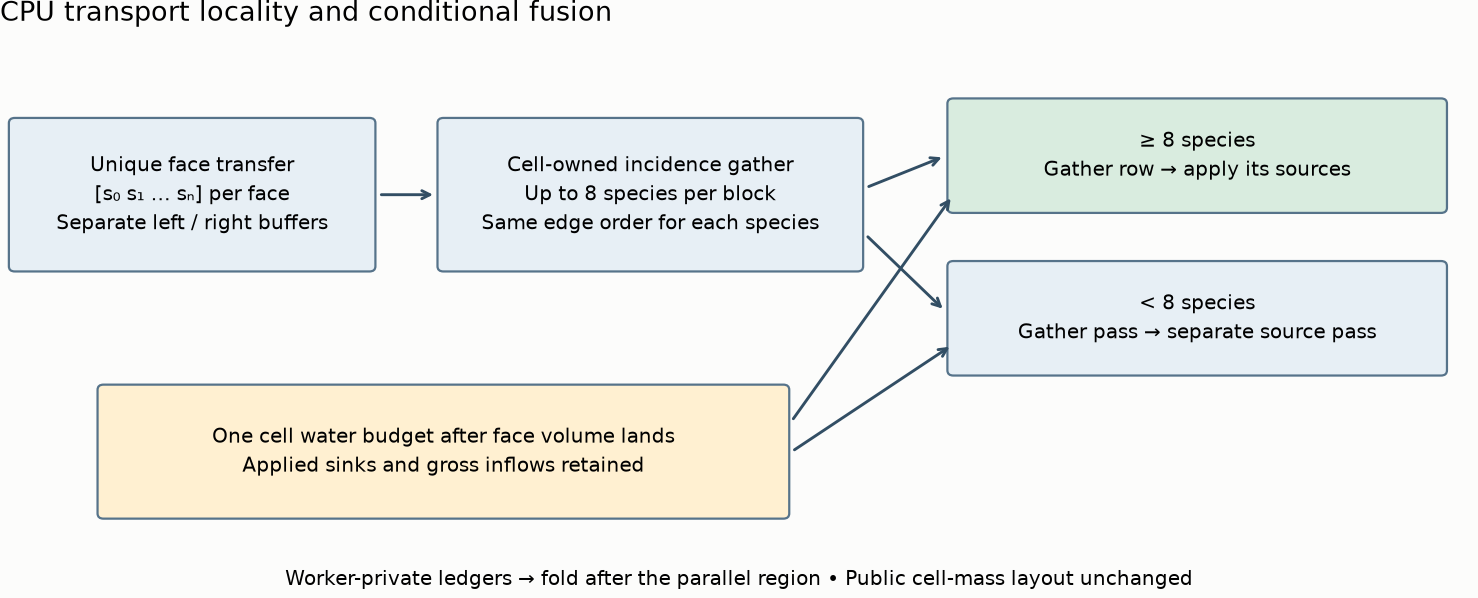
Figure 7-1 Face-local species storage, cell-owned gathering and the conditional fused source pass. Both routes preserve the same physical budgets.
Restrict additional reconstruction work to where it is needed. Wet interiors use the Green–Gauss path. Only shoreline stencils attempt the conditioned least-squares fit, and only for elevation and depth. A small connectivity mask is reused across stencil passes. Fully connected wet interiors already have positive bounded face depths; omitted shoreline and boundary faces require the extra positivity check. Thin or poorly conditioned stencils keep zero gradients.
Reduce face-kernel overhead. The second-order face loop computes its centroid-to-midpoint arms directly from edge midpoint and cell centroid coordinates, avoiding two searches through cell incidence lists. The limiter still uses its existing incidence arms. CPU-local force-inlining of the small SWE helpers removes measured call overhead; the macro is restored after inclusion and does not change the shared GPU annotation. Compiler fallbacks remain for unsupported force-inline attributes.
Storage cost is explicit. The elevation-gradient vectors each contain two cell-count blocks: elevation then depth. Thus depth reconstruction adds two arrays of doubles, approximately 16 bytes per cell, relative to the earlier elevation/velocity gradient storage. Velocity gradients and RK stage buffers remain separate. The layout/fusion optimizations do not add another persistent species-buffer copy. OpenMP static cell/face loops retain independent writes and explicit reductions.
The implementation is in src/engine/2d/solver/ExplicitInertialSolver.cpp and .hpp; SweKernels.hpp defines the flux, pressure corrections and friction. InertialEdges supplies geometry and incidence. Public options remain in SolverOptions2D.hpp. In particular, faceFluxReconBed is the current second-order kernel; faceFluxRecon is the constant-bed compatibility entry point.
The final cumulative comparison uses the corrected implementation before CPU phase 1 as its reference, with both solvers compiled against the same supporting engine build. Each authored model has 32,768 triangular cells, four threads, four local-time tiers, local-inertial momentum, one minute of rain/infiltration, a drain/pipe connection and HDF5 output. CPU time includes initialization and output. Three randomized measured pairs follow one discarded warm-up pair. States, ledgers, normalized reports and all HDF5 contents match exactly in every pair.
| Transported species | Median paired CPU reduction | Paired reduction range |
|---|---|---|
| 0 | -1.9% | -2.3% to 6.9% |
| 8 | 40.9% | 38.2% to 41.6% |
| 32 | 52.5% | 52.0% to 59.4% |
Positive reduction means less CPU time. The water-only control has no consistent benefit. Larger water-only cases in earlier scaling runs also showed small CPU regressions. Do not interpret the species savings as a universal 2D speedup or add percentages from different phases.
The revised second-order reconstruction has a separate benefit: lower cost at better analytical depth accuracy. The three-period Thacker comparison in Chapter 9: Two-Dimensional Overland Flow Analysis §9.10.1 uses a 96-division final mesh against the earlier reconstruction at 128 divisions and measures about 60% less CPU time. Those are different resolutions and a different reference from the cumulative species test. Phase 10 separately preserved numerical results while reducing CPU time by about 11–15% in component cases and 12–19% in authored wet coupled cases. Five further hotspot prototypes in phase 11 were rejected because their gains were small or inconsistent; they are not in production.
These measurements were made on an Apple ARM64 Mac with ten logical CPUs. The final run's one-minute load average ranged from 7.4 to 13.5. Review workloads were serialized, but unrelated system work remained. CPU time includes worker execution and OpenMP spinning; it is not an instruction count. Wall time and optimal thread count can differ on an idle host or another architecture. No claim is made for GPU speed.
Use three distinct comparisons rather than one aggregate score:
The final matched CPU regression build passed 169 tests with one unavailable Kokkos OpenMP plugin test skipped. The new qualification has 24 complete coupled executions, eight analytical diagnostic executions and 32 analytical timing executions. Prior hash-verified evidence adds 140 analytical executions and 24 coupled executions from phase 10; those were not rerun or relabelled as fresh phase-12 results. The regression suite includes source competition, macro-boundary settlement, thread safety, groundwater transfers, wet-face flux consistency, pressure forces and distorted shoreline velocities.
The evidence is under reviews/cpu_2d_2026_10_03:
| Directory | Purpose |
|---|---|
fixes | Initial correctness fixes, analytical problems and regression evidence |
cpu_phase2, cpu_phase4, cpu_phase5, cpu_phase6 | Sparse work, species layout/fusion and scaling |
accuracy_phase7, accuracy_phase8, accuracy_phase9 | Reconstruction development, negative experiments and final numerical checks |
cpu_phase10 | Retained face-kernel optimization, analytical equivalence and wet coupled checks |
cpu_phase11 | Rejected hotspot prototypes and their measurements |
cpu_phase12 | Direct cumulative comparison, accuracy/cost comparison and final qualification |
Within phase 12, prepare.py, the build scripts, check_suites.py, cumulative.py, accuracy_cost.py and finish_review.py record the reproduction workflow. Command manifests record compiler/link flags; source manifests identify the implementations. Frozen source trees, matching supporting objects, external Bellinge data and generated binary outputs are ignored local prerequisites. The scripts are review records, not a standalone portable benchmark distribution. Do not mix solver and supporting-engine objects from incompatible header/layout snapshots.
For a new deployment comparison, build both references with the same compiler/settings and supporting code; keep original model physics; record thread count, active fraction, step/face counts and output cadence; run warm-ups followed by randomized adjacent pairs; serialize benchmark jobs; then verify the intended numerical equivalence before reporting timing ratios. The reviewed component builds use O3/native CPU with fast math disabled and floating-point contraction disabled. Changing arithmetic settings requires a new correctness comparison.
Managed global-RK2 integration checks also cover skewed all-quad and mixed triangle/quad meshes with heterogeneous aquifers, independent chemical/thermal grids, both boundary domains, reactions, age and optional latent heat. Physical budgets and numerical/combined output histories pass together; this does not establish general spatial order on distorted meshes. See the groundwater transport design for the integration/restart capability matrix.
The remaining boundaries are further thermal and borrowed-owner support for RK2, long-period damping, mesh-dependent stability, production-catchment accuracy and hardware portability. The planned CPU review is complete; future optimization should follow a measured deployment bottleneck.
 1.13.2