 |
OpenSWMM Engine
6.0.0-alpha.4
Data-oriented, plugin-extensible SWMM Engine (6.0.0-alpha.4)
|
|
OpenSWMM Engine
6.0.0-alpha.4
Data-oriented, plugin-extensible SWMM Engine (6.0.0-alpha.4)
|
A first-order decay coefficient on a [POLLUTANTS] row is enough for a tracer study and not enough for chemistry. Chlorine decays at a rate that depends on temperature; two species react with each other; a wall demand differs from a bulk demand. Those need a reaction system: species, coefficients and rate expressions the engine evaluates.
OpenSWMM configures one as a process component with its own file. This chapter builds the smallest useful system — one species whose decay rate follows the water temperature the heat component computes — and is candid about what this release does and does not let you see.
Deck: docs/figures/decks/transport_demo/transport_demo.inp with transport_demo.rxn
The five-conduit line of Chapter 8. The reaction system adds one bulk species, CL2, decaying first order with an Arrhenius correction:
TEMP in that expression is a hydraulic variable available to every expression: when the heat component is on it is the computed water temperature, and when it is off it is the [REACTION_OPTIONS] TEMPERATURE fallback. That single identifier is the whole coupling between the two components.
A component is named by its identifier and given a configuration file. Nothing else in the deck changes; remove the line and the system is gone. The sections may also be embedded directly in the .inp, which is supported as a convenience — but embedded sections are read and not written back when the model is saved, and the engine warns before that happens.
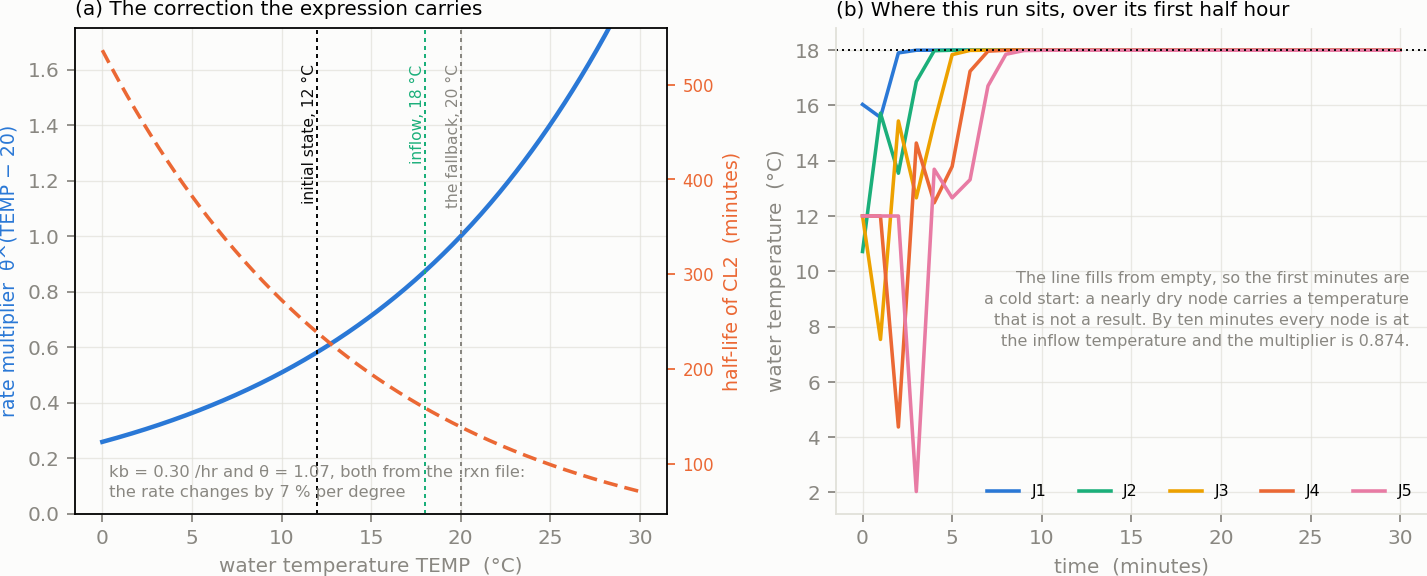
Figure 9-1 What the computed water temperature does to a reaction system's rate, through the Arrhenius correction in its expression
The correction is the point of coupling heat to reactions. At θ = 1.07 the rate changes by 7 % per degree, so the half-life of CL2 runs from 230 minutes in 12 °C water to 139 minutes at 20 °C. A model that leaves HEAT_TRANSPORT off evaluates the same expression at the fallback temperature and gets the 20 °C answer everywhere, all year.
On this deck the effect is small, and it is worth seeing why. Panel (b) is the run's own temperature: the line fills from empty, the nodes pass through a cold-start transient in the first minutes, and by ten minutes every node sits at the inflow temperature of 18 °C, where the multiplier is 0.874. The deck is too short and too fast for the water to warm; a reach with a real residence time is where the correction earns its keep.
Do not read the first minutes. A node that is nearly dry and filling carries a temperature computed from a vanishing volume — the 2 °C excursion at J5 at three minutes is that, not a physical result. The same caution applies to every concentration during a cold start.
Reaction species are written as named native result columns after pollutants, water age and temperature. The original figure above illustrates the thermal rate multiplier; it does not display the species concentrations. Species columns are available to the output reader and GUI even when they are absent from [POLLUTANTS].
[REACTION_REPORT] can select a subset without changing what the engine computes:
[REACTION_SOURCES] accepts CONC, MASS, FLOWPACED and SETPOINT sources, optionally modulated by cyclic [REACTION_PATTERNS]. MASS uses declared mass units per second. FLOWPACED doses arriving water; SETPOINT raises the mixed concentration during positive water exchange and never removes species. [REACTION_PARAMETERS] overrides PARAMETER coefficients on nodes and links.
[REACTION_SUBCATCHMENTS] supplies global or named-subcatchment wet laws. Its first-order split mixes retained mass with rain/run-on, reacts, then allocates infiltration, runoff and storage. [REACTION_BUILDUP] independently reacts dry land-use inventories, in declared mass per AREA_UNITS, before accrual, sweeping and washoff. Check WET_STEP/DRY_STEP sensitivity.
[REACTION_LIDS] opts controls into separate BULK layer reactors and retained inventories. Conventional units require full coverage and every unit to opt in. Storage-node bucket/Richards reactors require LEGACY quality and a non-Mesh bottom. Partial capture, covered barrels, WALL chemistry and 2D-owned conventional units remain refused. Full native checkpoints carry these inventories; state-only hotstarts refuse them.
WALL_GEOMETRY YES enables AV (AREA_UNITS/litre). Conduits derive contact from wetted perimeter, physical length and barrels; storage uses explicit [REACTION_WALLS] areas. WALL density refers to fixed reference area, with wetted-fraction kinetics and retained dry mass. ARD falls back to LEGACY for WALL systems; LAGRANGIAN refuses them. LEGACY/LAGRANGIAN tank kinetics skip zero/sub-litre water; ARD retains its 1e-9 ft³ store threshold.
Exact native checkpoint/output continuation is checked for CPU 1D network, wet/dry subcatchment and qualified LID chemistry. Heat/age, active 2D chemistry, subsurface laws, pollutants and detailed ARD/LID result streams remain outside this profile. Native hotstart inventory loading has a separate contract.
[REACTION_*] entries — the grammar of each section  1.13.2