 |
OpenSWMM Engine
6.0.0-alpha.4
Data-oriented, plugin-extensible SWMM Engine (6.0.0-alpha.4)
|
|
OpenSWMM Engine
6.0.0-alpha.4
Data-oriented, plugin-extensible SWMM Engine (6.0.0-alpha.4)
|
Two questions a concentration cannot answer. How long has this water been in the system? — which governs disinfectant decay, septicity and the credibility of a first-flush argument. And what temperature is it? — which governs reaction rates, dissolved oxygen and what the receiving water gets.
OpenSWMM answers both with reserved species carried by the same transport engine that carries the pollutants: __WATER_AGE__ and __TEMPERATURE__. Each is switched on by one [OPTIONS] key and configured by its own component file.
Deck: docs/figures/decks/transport_demo/transport_demo.inp with transport_demo.age and transport_demo.heat
The five-conduit line of Chapter 8, starting empty, filled from t = 0 by a constant 0.2 m³/s inflow at 18 °C while the air warms from 12 °C to 22 °C over six hours.
Water age needs its source ages:
Heat needs its sources and the flux modules to run:
together with the deck's own meteorology:
The [SOLAR_RADIATION] block gives the site's latitude, longitude, time zone and elevation, which is what SHORTWAVE COMPUTED needs to place the sun.
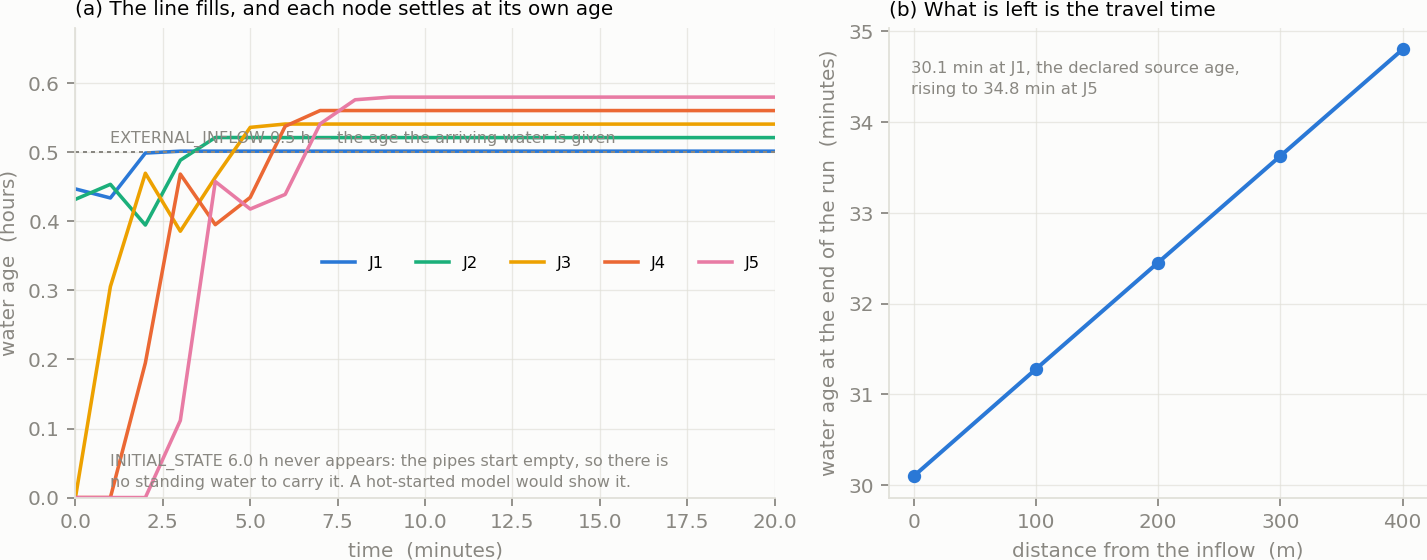
Figure 10-1 Water age along the line as the initial water is flushed out, and the travel-time profile it leaves
| Node | Water age at the end of the run |
|---|---|
| J1 | 30.1 min |
| J2 | 31.3 min |
| J3 | 32.5 min |
| J4 | 33.6 min |
| J5 | 34.8 min |
Table 10-1 The steady age profile — the declared source age plus travel time
Age is a clock the water carries, not a property of the pipe. Every node settles at the age its arriving water was given plus the time it took to get there: 30 minutes at J1, which is the declared EXTERNAL_INFLOW 0.5 h, rising by about 1.2 minutes per 100 m of pipe. The gradient is the travel time, and it is the number a residence-time argument actually needs.
INITIAL_STATE 6.0 h never appears. The pipes in this deck start empty, so there is no standing water to carry the initial age. In a model started from a hot-start file, or one with storage that begins full, that source dominates the first hours and the flushing of it is the interesting part of the answer. Declaring an initial age is cheap insurance; the value only matters if there is water to carry it.
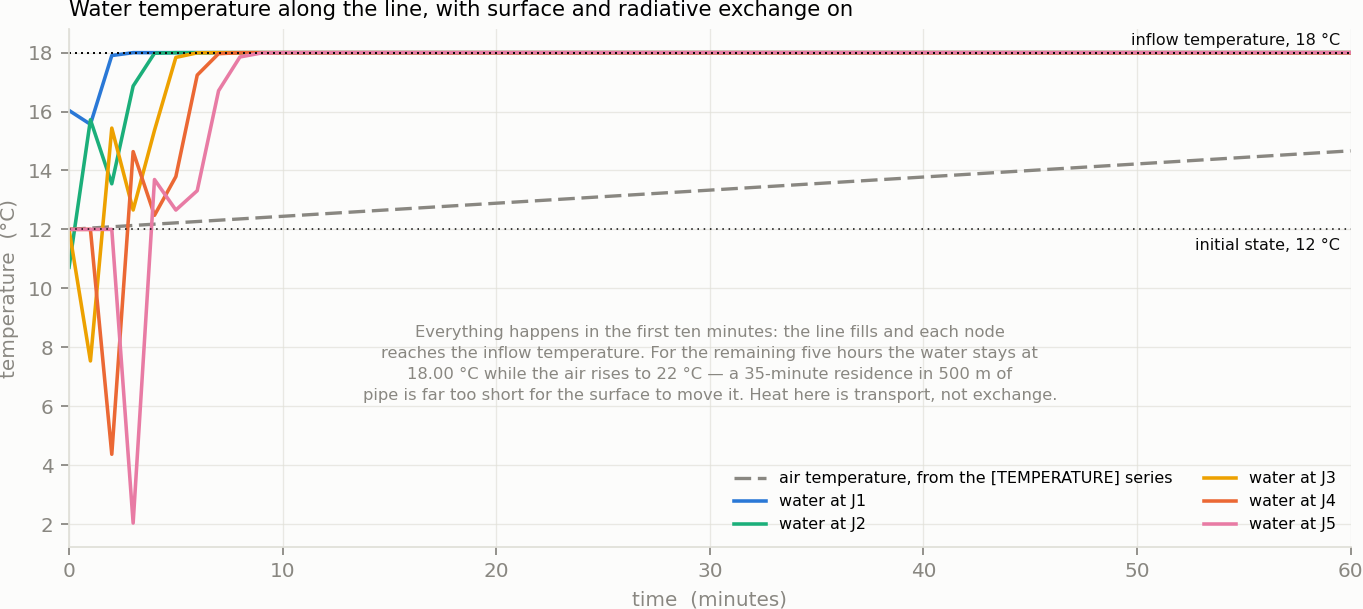
Figure 10-2 Water temperature along the line against the air temperature driving it
Here, heat transport is transport. The water arrives at 18 °C and stays at 18.00 °C for the whole run while the air climbs to 22 °C. With surface exchange and radiative exchange both on, a 35-minute residence in 500 m of pipe is far too short for the atmosphere to move the water temperature measurably. The component is doing its job — it carried the inlet temperature down the line and mixed it correctly at every node — and the exchange terms have almost nothing to work with.
That is the general shape of the result for a conveyance system. Surface exchange matters where water is slow and exposed: a detention pond, an open channel, a long shallow reach, an LID surface. It does not matter much in a 500 m sewer.
Read the cold start with suspicion. The excursions in the first minutes of Figure 10-2 — down to 2 °C at J5 — are nodes that are nearly dry and filling fast. A temperature is the property of a volume of water, and when that volume is a few litres arriving into an empty pipe, the number is arithmetic rather than physics. Start the reporting after the system has filled, or hot-start it.
 1.13.2