 |
OpenSWMM Engine
6.0.0-alpha.4
Data-oriented, plugin-extensible SWMM Engine (6.0.0-alpha.4)
|
|
OpenSWMM Engine
6.0.0-alpha.4
Data-oriented, plugin-extensible SWMM Engine (6.0.0-alpha.4)
|
A full pipe over a summit, drawn down from one end, develops pressure below atmospheric at the high point. Inverted siphons do it, pumped mains do it when a pump trips, and a sewer does it whenever a downstream control drains a surcharged reach faster than the upstream end can follow.
A Preissmann slot cannot represent that. The slot is a narrow shaft added above the crown so the free-surface equations keep their form when the pipe fills; it is open to the atmosphere by construction, so the water surface inside it cannot describe a pressure lower than the air above it. The two-component pressure approach carries the pressurised part of the state as a second component instead, and that component is free to go negative.
This chapter runs the experiment that separates them.
Deck: docs/figures/decks/negative_pressure/negative_pressure.inp
The pipeline of Chapter 2 with its centre raised 0.15 m — 2 % up to the summit, 2 % down from it — both ends at elevation zero. The system starts full and at rest, filled to 0.30 m at the upstream box, which puts the summit's crown under water. At t = 0 a siphon withdrawal of 0.45 L/s starts, the upstream level falls, and the pressure at the summit follows it down.
The gauge stations are sealed junctions (SUR_DEPTH 30), not plain junctions: a plain junction is an atmosphere contact and would vent the pressurised state — right for a manhole, wrong for a transducer tapping on a sealed pipeline. The comparison window ends at 40 s, where an air cavity intrudes in the laboratory and the single-phase model stops being a model of the experiment.
and, for the dynamic wave runs,
REPORT_SIGNED_HEADS is what lets the report carry a head below the pipe invert rather than clamping it. Without it the interesting part of the answer is silently truncated at zero.
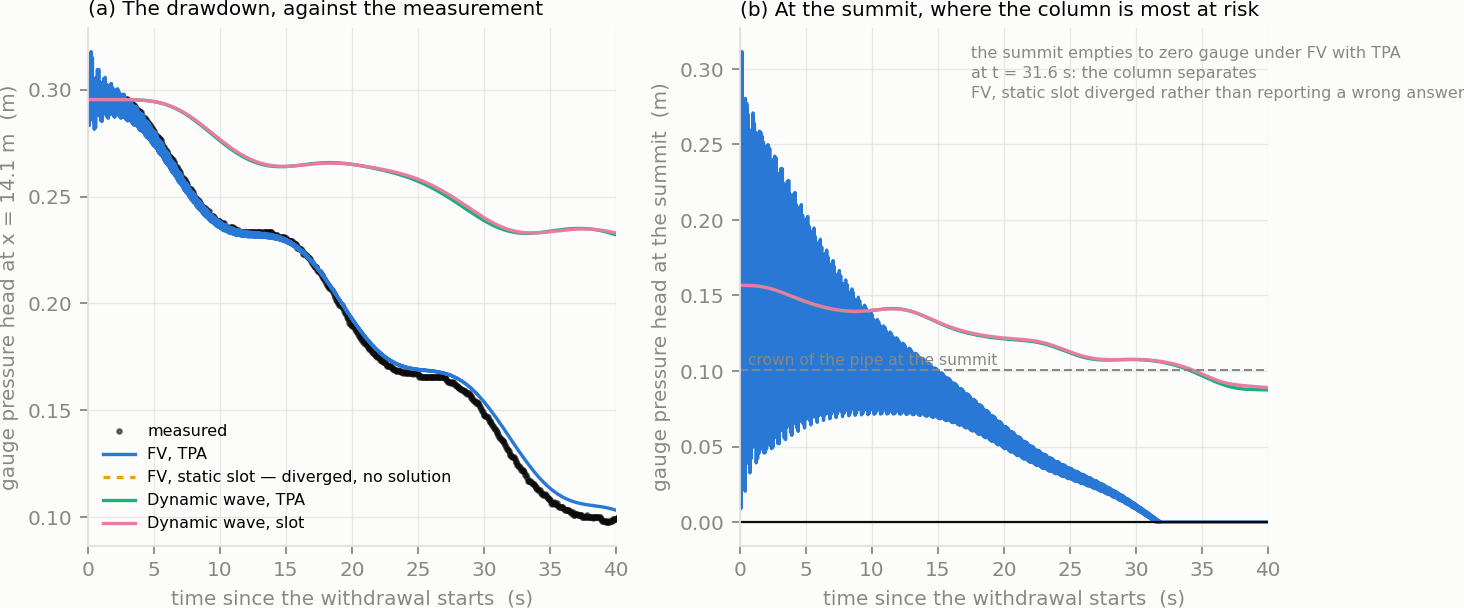
Figure 3-1 Piezometric head at x = 14.1 m and velocity at x = 9.9 m in the siphon experiment, under both closures on both routers
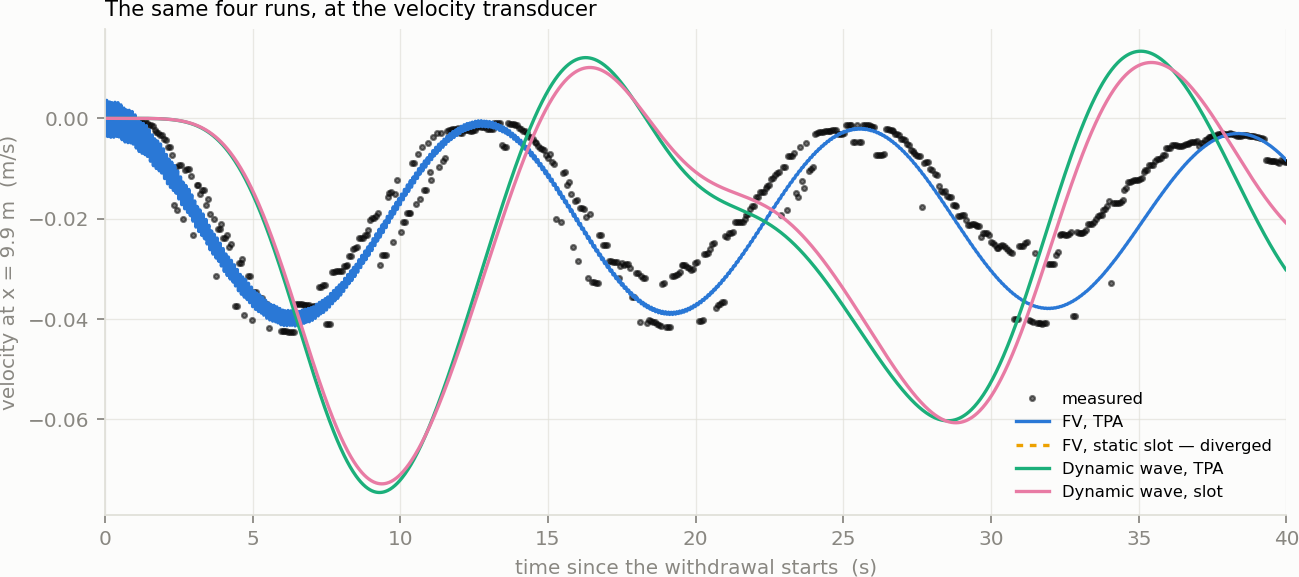
Figure 3-2 The same four runs at the velocity transducer, where the closures diverge after the drawdown
| Gauge head at x = 14.1 m, t = 40 s | Routing continuity error | |
|---|---|---|
| Measured | 0.099 m | — |
FV, TPA | 0.103 m | −0.000 % |
FV, static slot | diverged — ERROR 14 in the first substeps | — |
DYNWAVE, TPA | 0.232 m | −10.434 % |
DYNWAVE, slot | 0.233 m | −11.118 % |
Table 3-1 The drawdown each formulation reports, against the measurement
The static slot does not produce a wrong answer here; it produces no answer. Under the finite-volume router with FV_PRESSURE_CLOSURE SLOT the run stops in the first substeps with ERROR 14, a depth magnitude of 13 000 ft in the conduit downstream of the summit. That is the right behaviour for a closure asked to represent a state it has no representation of: the slot must keep a free surface, the state has none, and the solution runs away. A closure that quietly returned zero would be worse.
With the right closure, the finite-volume run is the experiment. It tracks the measured drawdown through all four of its stages and ends within 4 mm of the measurement after 40 s, with continuity at −0.000 %. Panel (b) of Figure 3-1 shows why the summit is the interesting station: the acoustic oscillation at 300 m/s is visible and decaying, and the summit reaches zero gauge pressure at t = 31.6 s — the column separating, which is the physical event the experiment was built to produce.
The dynamic wave runs fail differently, and quietly. Both closures give the same answer to within a millimetre, and both drain the system less than half as fast as the measurement: 0.232 m against 0.099 m at 40 s. TPA does not rescue the dynamic wave router here, because the problem is not the pressurisation closure — it is that a single flow per conduit cannot carry the acoustic wave that governs how fast a full pipe responds. The continuity errors, −10.4 % and −11.1 %, say so plainly: these runs are not conserving the water they were given.
The velocity trace is the same story in a different variable. Figure 3-2: the finite-volume run follows the measured oscillation in phase and in amplitude; the dynamic wave runs overshoot by roughly a factor of two and drift out of phase by five seconds over the window.
One caution. FV_PRESSURE_CLOSURE TPA is Experimental, and this chapter is exactly the case it exists for. Its caveats — the integrator choice, the pinned cases, the measured behaviour under different acoustic celerities — are in Hydraulics 8, §8.4.5, and they should be read before a TPA result is trusted on a system that is not this one.
 1.13.2