 |
OpenSWMM Engine
6.0.0-alpha.4
Data-oriented, plugin-extensible SWMM Engine (6.0.0-alpha.4)
|
|
OpenSWMM Engine
6.0.0-alpha.4
Data-oriented, plugin-extensible SWMM Engine (6.0.0-alpha.4)
|
This chapter describes what the water of the overland flow solver (Chapter 9: Two-Dimensional Overland Flow Analysis) carries. The mesh is a fourth domain species can occupy, beside subcatchment runoff, the legacy aquifers and the 1D network, and the first question is which classes travel there.
That question is answered in one place — the transport policy — rather than re-derived by each solver. Four classes are recognised: pollutants ([POLLUTANTS]), the reaction system's species (Chapter 8), water age (__WATER_AGE__) and temperature (__TEMPERATURE__). For each domain, each class resolves to enabled with a row count, disabled by the user naming the key, or unavailable with the reason. For the 2D surface the gates fire in this order: no mesh — unavailable; the class off at project level ("no [POLLUTANTS]", "no reactions component", "WATER_AGE OFF", "HEAT_TRANSPORT OFF") — unavailable; [OPTIONS] IGNORE_2D YES — disabled; IGNORE_QUALITY YES — disabled, for pollutants and MSX species only, since age and temperature are their own options on the mesh as in 1D; a WALL species in the reaction system — MSX unavailable, since a wall-attached species has no meaning on a sheet of water and the class is left off with a warning rather than carried half; the matching [2D_OPTIONS] key below set to NO — disabled, naming the key; otherwise enabled.
| Key | Values | Default | Effect on the mesh |
|---|---|---|---|
TRANSPORT_POLLUTANTS | YES or NO | YES | Carry the [POLLUTANTS] rows |
TRANSPORT_MSX | YES or NO | YES | Carry the reaction system's species |
TRANSPORT_AGE | YES or NO | YES | Carry __WATER_AGE__ when WATER_AGE ON |
TRANSPORT_TEMPERATURE | YES or NO | YES | Carry __TEMPERATURE__ when HEAT_TRANSPORT ON |
DISPERSION | m²/s, finite, non-negative | 0 | Isotropic dispersion (§10.2); negative is refused, not clamped |
The policy is inherit-on (Section: [2D_OPTIONS]): a class enabled at project level runs in every domain whose solver carries it unless a key says otherwise. Rows take the canonical order the Eulerian 1D engine uses — pollutants, MSX species in declaration order, the age row, the temperature row last. Whenever a project declares any class, the resolved matrix is printed in the .rpt header, one row per domain, with on(n), off:KEY or n/a per class and one explanatory line per n/a cell; the C API and the GUI read the same matrix. Transport rows are integrated by the CPU marcher; the Kokkos backends carry none, so a project with any class enabled on the mesh runs on the CPU whatever the backend setting.
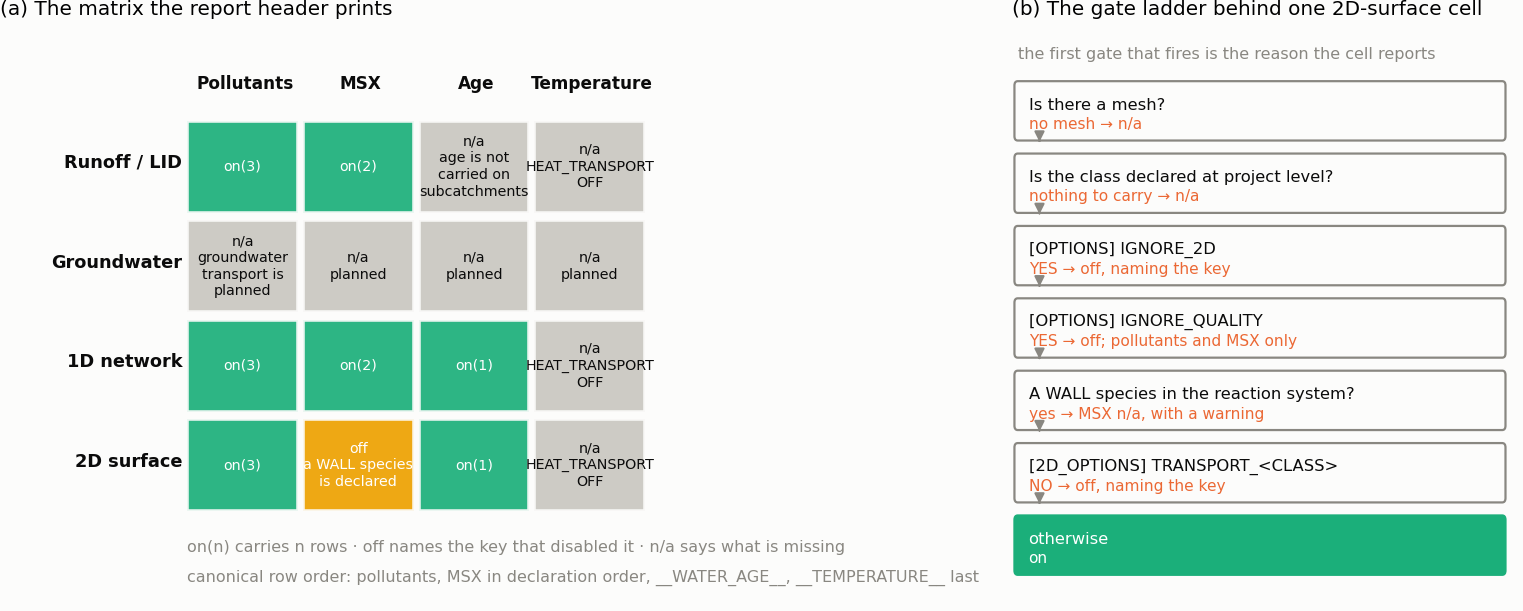
Figure 10-1 The transport policy matrix: which species class moves in which domain, and the gate ladder the 2D surface passes
The hydraulic solver's integrated state is the cell volume; depth and head are reconstructed from it. The transport state follows the same rule: what is stored per cell is species mass \(m_{s,i}\), species-major, and concentration is derived,
\[c_{s,i} = \frac{m_{s,i}}{V_i}\] | (10-1) |
reported as zero when \(V_i\) lies below the hydraulics' dry-volume threshold. A cell that empties keeps what it held, and no concentration has to be extrapolated against a vanishing volume. The temperature row is the one signed row — water below 0 °C is a state — so every non-negativity guard in the marcher and the coupling queue skips it, as in 1D (Chapter 9).
Per cell \(i\) and species \(s\), in mass form:
\[\frac{dm_{s,i}}{dt} = -\sum_{e \in \partial i} Q_e\, c_{s,\mathrm{donor}(e)} + \sum_{e \in \partial i} \frac{D\, h_e\, \xi_e}{d_e}\,(c_{s,j(e)} - c_{s,i}) + V_i\, r_s(\mathbf{c}_i, T_i) + S_{s,i}\] | (10-2) |
with \(Q_e\) the face volume flux the marcher computed, \(D\) the isotropic dispersion coefficient, \(h_e\) the face depth, \(\xi_e\) the face length, \(d_e\) the normal centroid distance, \(r_s\) the reaction rate and \(S_{s,i}\) the sources of §10.2.5 — Chapter 7's equation for a cell of the mesh, differing chiefly in how the first term is evaluated.
The advective flux is booked inside the same face firing that moves the water. When the marcher commits a volume \(\Delta M\) across a face — after the Froude cap and the positivity share, so it is the volume that actually moves — the mass \(\Delta M \cdot c_{\mathrm{donor}}\) leaves the donor and arrives at the receiver, with the donor concentration read at that substep against the same published volume the share was budgeted from. First-order donor-cell upwinding is the only scheme on the mesh; the limited second-order reconstructions of the 1D engines are not offered (§10.11).
Two properties follow: the species flux cannot disagree with the volume flux about cadence, direction or magnitude, so a uniform field stays uniform under arbitrary flow, across local-time-stepping tiers and through wet/dry fronts; and the scheme conserves to round-off, one writer per face. The donor read guards on \(V > 0\) alone, not on the dry depth, so a face that fires at a wet/dry front exports at the exporter's true concentration.
[2D_OPTIONS] DISPERSION sets one isotropic coefficient in m²/s. The exchange is an explicit two-point flux booked on the same face, at the same cadence, into the same accumulators as advection:
\[\Delta m_{a \to b} = D\, h_e\, \xi_e\, \frac{\Delta t_e}{d_e}\,(c_a - c_b)\] | (10-3) |
An explicit parabolic term has its own stability limit, \(D\,\Delta t / d_e^2 \lesssim \tfrac{1}{2}\), and the marcher's substep is set by gravity waves, not by \(D\). Rather than couple the global step to a local term the exchange is limited so the pair can never cross: at most one third (one quarter for a quadrilateral receiver) of the amount that would equalise the two concentrations — pairwise bounds do not compose across a cell's faces — and at most the \(\beta\) share of the giver's mass the volume flux is held to; the signed temperature row takes the equalisation bound alone. A face on which the limiter binds is counted and reported as a warning at the end of the run: the physics stayed bounded, but the dispersion rate there was less than asked for. With DISPERSION 0 the block is not entered.
| Pathway | Pollutants and MSX | Age | Temperature |
|---|---|---|---|
| Rainfall | At the [POLLUTANTS] rain concentration; MSX rows rain in clean | Age 0 | The RAINFALL source temperature of [HEAT_SOURCES] |
| Evaporation | Removes water and no solute — the concentration rises | Removed at the cell's mean age | Removed at the cell's mean temperature |
| Infiltration | Removes mass at the cell concentration; booked to a named ledger | Same | Same |
| Boundary outflow | Leaves at the cell concentration | Same | Same |
| Boundary inflow | At the [2D_BOUNDARY_QUALITY] value, else clean | Same | Same |
| 1D coupling | §10.4 | §10.4 | §10.4 |
| Washoff | §10.7 | Does not build up | Does not build up |
Age and temperature are carried as age-volume and temperature-volume, so for them the evaporative sink is applied at the cell's own mean — leaving either untouched while the volume fell would age or heat the cell by evaporating it.
After each advance the age row gains exactly \(\Delta t\,V_i\), so every wet cell's mean age grows by the step — Chapter 9's law. The reaction stage then runs on a concentration view of the wet cells (volume above DRY_DEPTH·area) through the same reactArdStage the Eulerian 1D engine uses: pollutant first-order decay by exact exponential, booked to the reacted ledger, and multi-species kinetics in pipe scope — an overland cell is a flowing element, not a tank — against the cell's own temperature row where heat is on. Dry cells are skipped; the age and temperature rows do not react.
Two sections seed and force the rows; both may be placed in the .inp or in the external mesh file named by [2D_MESH_FILE].
[2D_INITIAL_QUALITY] (Section: [2D_INITIAL_QUALITY]) sets the starting concentration by scope — * for the whole mesh, TAG name, or CELL n with a 1-based index, triangles first then quadrilaterals. A species is named as it appears in the row list: a pollutant id, a reaction species id, __WATER_AGE__ (authored in hours, carried in seconds) or __TEMPERATURE__ (°C). Negative and non-finite values are refused rather than clamped; a species the mesh does not carry is an open-time error. Without a row, pollutant, MSX and age rows start at zero and the temperature row at the INITIAL_STATE source temperature, as in 1D.
For the separate finite porewater reservoir in a LOCAL_STORAGE mesh bed, [2D_INITIAL_BED_QUALITY] uses the same global, mesh-tag and cell scopes. It seeds bed concentration using bed pore volume (cell area × bed thickness × porosity), with water age entered in hours. It requires coupled heat and a local-storage bed; groundwater-owned stores use [GW_INITIAL_QUALITY].
[2D_BOUNDARY_QUALITY] (Section: [2D_BOUNDARY_QUALITY]) gives the concentration carried by water entering through a boundary edge:
The edge is addressed by its owning cell and local edge index (0–2 on a triangle, 0–3 on a quadrilateral). The cell index here is 0-based — the TRI column of [2D_BOUNDARY_CONDITIONS], which the row mirrors — unlike the 1-based CELL n scope of the other sections. The edge must be a non-WALL boundary edge; a wall admits no water, so a row on one is refused at initialization. Only inflow carries the value; outflow always leaves at the cell's concentration. An edge with no row admits clean water — zero concentration, age zero, zero temperature-volume. Rows in a model that carries no transport rows are an error, not a silent no-op.
Everywhere the coupling moves water between a node and the mesh, a species tuple moves with it at the donor's value.
Mesh to network. A 2D→1D drain leaves at the cell's concentration, accumulated per coupling point over the exchange window. At the window's end the router hands each node the drained mass through the same queue the volume takes, in the 1D engines' units, so mass over volume is still the cell's concentration exactly. Rows route by kind: pollutant rows into the node's species queue, the age row into the age-volume queue, the temperature row into the temperature-volume queue. MSX rows go nowhere — the 1D node has no reaction-species inflow accumulator for any loader yet — and their drained mass stays in the surface's coupling-loss ledger (§10.11). A rim that flip-flops within one window would hand the node gross mass with net water and make a junction fed at \(c_0\) read above \(c_0\), so the router pairs the window's spill against its drain first, at the node's published value, and leaves only the net-negative remainder to the node's volume drop, which removes it at the mixed concentration.
Network to mesh. A junction spill arrives at the node's published row values, frozen for the batch like the node head. All three 1D engines publish nodes.conc, the reaction system its node concentrations, the age and heat modules their node states, so the coupling reads one array and is engine-independent; nothing is queued back, since the node's CSTR mix already takes the spill at the mixed concentration. An outfall discharging onto the mesh carries its published values through a per-cell mass-rate density that scatters exactly as its volume does. Water arriving this way, or through an inflow boundary, is not runoff the cell produced (§10.7). Every pathway is ledgered per species.
Chapters 3 and 4 (Chapter 3 - Surface Buildup, Chapter 4: Surface Washoff) describe buildup and washoff on a subcatchment through its land-use coverages. The mesh adopts the same convention: land uses are not redefined; a cell only says which of the model's [LANDUSES] cover it and by what percent, and the relations come from the same [BUILDUP] and [WASHOFF] tables.
The ladder is *, then TAG, then CELL (1-based), later scopes overriding earlier ones (Section: [2D_COVERAGES]). A row replaces the whole coverage set for its scope rather than merging — exactly as a subcatchment's [COVERAGES] line does — so CELL 812 above carries Park alone. Percentages per scope sum to at most 100; the remainder carries no land use. An unknown land use, a tag matching no cell, or a cell beyond the mesh is an open-time error, as is a model with no [LANDUSES] or no transported rows. The rows are inert with a warning under [2D_OPTIONS] RAINFALL_MODE NONE — no rain falls on the mesh, so the subcatchments own the surface — and when loadings or curb lengths are given without any coverage.
Ownership. A subcatchment whose footprint is meshed and rained on already sends its own washoff to its outlet; cells under it that also carry coverages would load the same storm twice. At open, every covered cell whose centroid lies inside a subcatchment polygon that itself has [COVERAGES] is reported in one warning naming the subcatchments, and the run proceeds.
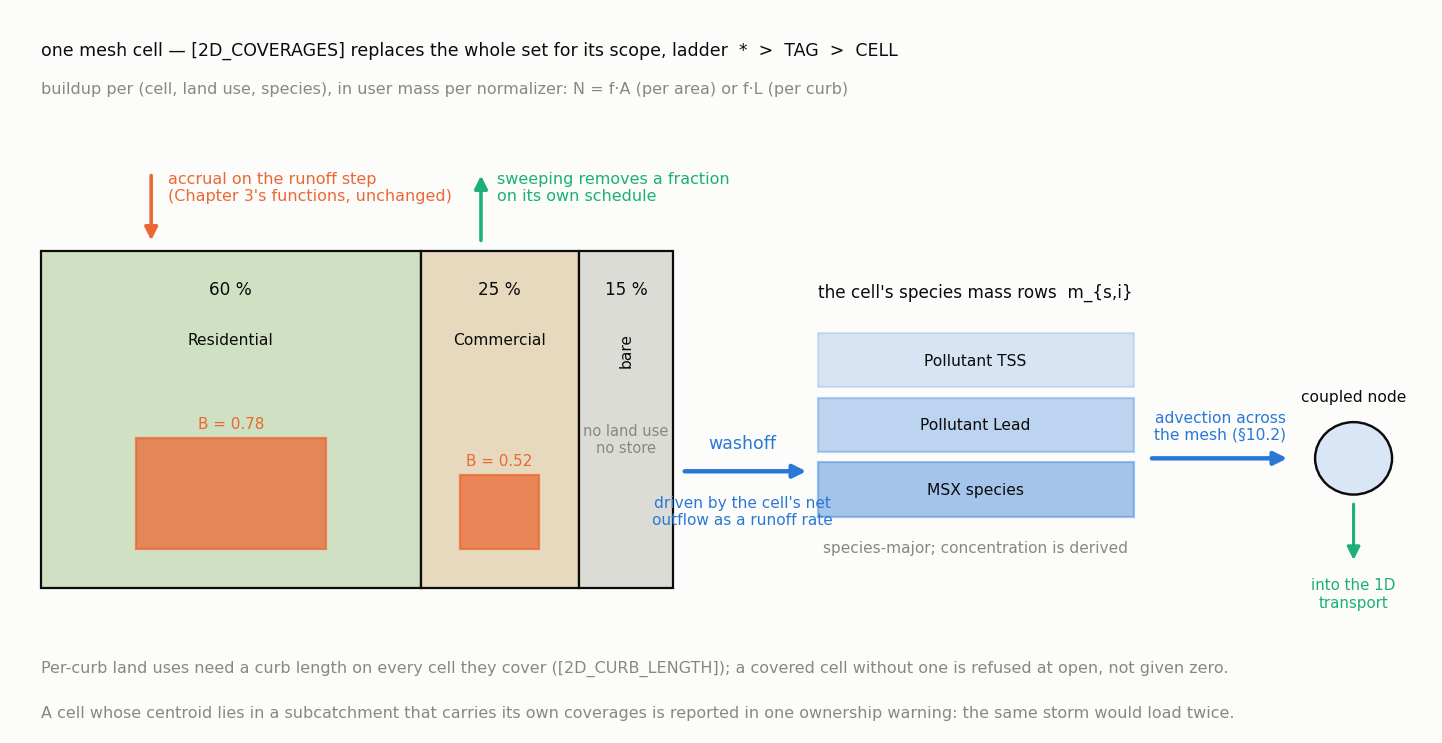
Figure 10-2 Buildup and washoff on one mesh cell: land-use slices, accrual, sweeping and the mass handed to the network
Buildup is held per (cell, land use, surface species) in user mass per normalizer unit, the quantity a subcatchment's store holds, where the normalizer is the covered land area or the covered curb length:
\[N_{c,l} = f_{c,l}\,A_c \quad (\text{per area}), \qquad N_{c,l} = f_{c,l}\,L_{c} \quad (\text{per curb})\] | (10-4) |
with \(f_{c,l}\) the coverage fraction, \(A_c\) the cell area in acres or hectares and \(L_c\) its curb length in project units. The functions are Chapter 3's, unchanged: power, exponential and saturation accrue through the inverse-days form the subcatchment step uses — the store is converted back to an equivalent age, the step added, the function re-evaluated — and EXTERNAL integrates its series rate, capped at the maximum. Accrual runs at the runoff step, right after the subcatchment surface-quality step, so cells and subcatchments share one calendar.
The initial store follows the subcatchment rule. A [2D_LOADINGS] row (Section: [2D_LOADINGS]), user mass per unit land area in the same scope grammar, seeds the store directly — for a per-curb land use it is converted by the cell's area-to-curb ratio. Without a row, the buildup function is evaluated at [OPTIONS] DRY_DAYS. A loading may name a pollutant or a reaction species; age and temperature do not build up. A land use whose buildup is PER_CURB needs a curb length on every cell it covers, from [2D_CURB_LENGTH] (Section: [2D_CURB_LENGTH]), same scope ladder, length in project units; a covered cell without one is an open-time error, refused rather than silently given zero curb.
The washoff laws of Chapter 4 need a runoff rate for the cell, and the right definition took two attempts. The one implemented is the cell's net outflow over the runoff step, per unit area:
\[q_c = \frac{\max\!\left(0,\ V_{\mathrm{out},c} - V_{\mathrm{in},c}\right)}{A_c\,\Delta t_{\mathrm{runoff}}}\] | (10-5) |
where \(V_{\mathrm{out}}\) is what left across the cell's faces, open boundary edges and drains to nodes, and \(V_{\mathrm{in}}\) what arrived across faces, from node spills, outfall discharge, prescribed inflow and inflow boundaries — accumulated by the marcher at every site the species ledgers already book, so the water side and the runoff side cannot disagree. Rainfall is generation, not inflow, and is not subtracted; infiltration is not runoff and is not added. By continuity the positive part is rain excess plus storage release — the runoff the cell itself produced, the analogue of the subcatchment's outflow over area: zero on a still pond, zero on a cell that only passes upstream water through, and independent of how finely a plane is meshed. A gross outward face flux was tried and withdrawn — it counts the same water once per cell it crosses — and rainfall excess alone rejected because it stops washing during the recession.
Each covering land use then applies its own relation per surface species, with the subcatchment step's unit conventions and minimum-runoff threshold: EXP, \(W = C_1\, q_c^{\,C_2}\, B\, N\); RC, \(W = C_1\,(q_c A_c)^{C_2}\); EMC, \(W = C_{\mathrm{emc}}\, q_c A_c\). EXP and RC are capped at the buildup available; EMC is not, and where no buildup function exists the mass it removes is booked to the buildup ledger so the closure holds. BMP removal is taken before delivery. What remains is added to the cell's species row and booked to the washoff ledger, from where it advects with the following steps' water and reaches the 1D node through the tuple of §10.4; every law reduces the store. The washoff of step \(n\) is computed from the runoff accumulated during step \(n\) and enters the rows at its end, one runoff step behind the water that produced it, and a hydrograph's last washoff stays on the drying cell until the next event. Co-pollutant fractions are not mirrored on cells.
Sweeping follows the [LANDUSES] schedule — interval and removal per land use — with one days since last swept counter per (cell, land use). The counter advances by the runoff step on days that are dry and inside the season given by [OPTIONS] SWEEP_START and SWEEP_END (a season wrapping the year end is handled); when it reaches the interval it resets and a sweeping event removes, per surface species,
\[\Delta B = B \cdot \frac{R_{\mathrm{removal}}}{100} \cdot \frac{E_{\mathrm{sweep}}}{100}\] | (10-6) |
with \(R_{\mathrm{removal}}\) the land use's removal percentage and \(E_{\mathrm{sweep}}\) the species' sweeping efficiency from [WASHOFF], booking the removed mass to the sweeping ledger. This is the subcatchment rule with the cell index in place of the subcatchment index; both counters start at zero, so a cell and a subcatchment with the same land use sweep on the same day.
Surface species are the union of the [POLLUTANTS] rows and the reaction system's species. [BUILDUP], [WASHOFF], [LOADINGS] and [2D_LOADINGS] accept a reaction species name as [INITIAL_QUALITY] and [INFLOWS] do, and the cell store is indexed by surface species from the outset — pollutants, then reaction species, the row order the policy fixes — so nothing in the arithmetic is pollutant-shaped. The one species-dependent input is the unit factor from concentration-mass to user mass: for a pollutant, the [POLLUTANTS] units as in Chapter 4; for a reaction species, its declared units — MG takes the mass conversion, UG a thousandth of it, anything else (MMOL, counts, dimensionless) is carried as-is, the pollutant COUNTS rule. Three pollutant-only mechanisms are deliberately not mirrored: co-pollutant fractions, rain concentration (reaction species rain in clean), and kinetics inside the dry store — a built-up reaction species is inert until washed into water, where it reacts under the normal pipe-scope expressions per cell. The WALL and node-accumulator limits of §10.1 and §10.4 apply.
The .rpt file. The transport matrix of §10.1 is printed in the header. When coverages are active, a 2D Surface Washoff Summary follows the subcatchment summaries: one row per surface species with the initial buildup, net buildup, mass washed off into the cell rows, mass swept, BMP removal and the store still on the mesh, in user mass (a reaction species declared in UG or as a count keeps its own unit), with the cell and land-use counts and the per-acre or per-hectare basis in the heading; "washed off" is what entered the rows, not a node load.
The .h5 results file. The REPORT_2D_VARIABLES tokens SPECIES and BUILDUP, both in the DEFAULT set, add two time-indexed variables; REPORT_2D_SPECIES narrows the rows written and REPORT_2D_STEP sets the cadence. The .out format has no 2D record.
| Variable | Shape | Units | Notes |
|---|---|---|---|
Mesh2_face_species_conc | time × species × cell | species units | Created on the first step that carries rows; species_names lists the rows written; __WATER_AGE__ in hours |
Mesh2_face_buildup | time × species × cell | user mass per acre or hectare | Pollutant and reaction-species rows; species_names and units attributes |
The C API. Coverage, loading and curb-length rows are readable and editable through openswmm_sq2d.h, sharing the file's parsers so the grammar exists once, and per-cell buildup is read with swmm_2d_get_buildup_bulk. Not in this release: a Mesh2_face_washoff variable, hotstart carry of the store and sweeping counters, per-species continuity rows for the mesh in the .rpt (the 2D continuity block reports water only), and Python and MCP mirrors of the coverage API.
| Formulation | Status | Where it stands |
|---|---|---|
| Mass-form state, donor-cell advection on the marcher's face fluxes (S1) | Implemented | The only advection scheme on the mesh |
| Isotropic explicit dispersion with the max-principle limiter (S2) | Implemented | [2D_OPTIONS] DISPERSION; binds counted and warned |
| Initial and boundary species; rainfall and evaporation rules (S2) | Implemented | §10.3, §10.2.5 |
| 1D↔2D species, age and temperature tuple (S3) | Implemented | §10.4; reaction-species drain not received by the node |
| Age, temperature and per-cell reactions (S4) | Implemented | §10.2.6 |
| Cell coverages, buildup, washoff and sweeping (S7) | Implemented | §10.5–10.8; the meshed-vs-lumped band gate is open |
| Reaction species that build up and wash off (BW-MSX) | Implemented | §10.9 |
| Limited second-order advection on the mesh | Planned | The plan placed it in S2 behind the 1D key names |
| Anisotropic dispersion tensor | Planned | Deferred until a field case shows the difference |
| Per-cell surface heat fluxes and shading (S5), then a cell-resolved bed layer | Planned | The CELL2D token exists; no flux evaluation on cells |
| GPU transport kernels (S6) | Planned | Rows run on the CPU marcher |
WALL species on the mesh; node-side MSX inflow accumulator; kinetics in the built-up store | Planned | Recorded seams of §10.1, §10.4 and §10.9 |
Mesh2_face_washoff, hotstart carry, 2D species continuity rows | Planned | §10.10 |
The transport state is src/engine/2d/data/SurfaceTransportState.hpp; the species flux, dispersion, sinks and sources are booked inside the marcher, src/engine/2d/solver/ExplicitInertialSolver.cpp (bookFaceSpecies, sinkMassAtCellConc, addRainMass, sinkIntensiveRowsWithEvap, addCouplingSourceMass). The router, src/engine/2d/SurfaceRouter2D.cpp, sizes the rows from the policy, resolves the initial and boundary rows, publishes the node row values, hands the drained tuple to the 1D queues and runs the aging and reaction stage. The policy is src/engine/transport/TransportPolicy.cpp. Coverages, buildup, washoff and sweeping are src/engine/2d/quality/SurfaceQuality2D.cpp, stepped from SWMMEngine::stepRunoff after the subcatchment and reaction-species surface steps (src/engine/quality/MsxSurfaceQuality.cpp). The .h5 variables are written by src/engine/2d/output/Default2DOutputPlugin.cpp, the .rpt blocks by src/engine/plugins/DefaultReportPlugin.cpp.
 1.13.2