 |
OpenSWMM Engine
6.0.0-alpha.4
Data-oriented, plugin-extensible SWMM Engine (6.0.0-alpha.4)
|
|
OpenSWMM Engine
6.0.0-alpha.4
Data-oriented, plugin-extensible SWMM Engine (6.0.0-alpha.4)
|
Water running down a street reaches a grate or a curb opening, some of it goes into the sewer, and the rest carries on to the next inlet. A model has to say how much goes in — which is a HEC-22 calculation from the spread, the depth at the curb and the inlet's design — and where the rest goes.
OpenSWMM offers two ways to attach an inlet, and they are not interchangeable. A conduit-attribute inlet is a property of a street conduit: [INLET_USAGE] names the conduit, the design and the node the captured water is delivered to, and the capture is booked at the conduit's downstream node. An inlet junction is a node of its own, sitting between two street conduits. This chapter runs both on one street and shows what each makes possible.
Deck: docs/figures/decks/street_inlets/street_inlet_junction.inp
One street reach draining to a parallel sewer:
ST_A carries a conduit-attribute inlet — a combination grate and curb opening, two of them — whose capture is delivered to MH1. IJ1 is an inlet junction between ST_B and ST_C carrying a single curb opening, delivering to MH2. The storm is a 2-hour event on a small catchment above the street.
The deck is a copy of examples/inlets/street_inlet_junction.inp; its header shows all four [INLETS] design grammars, including the two-line combination encoding and a custom design pointing at a diversion curve.
An inlet junction is a virtual junction that also carries an inlet, so it inherits every virtual-junction rule: exactly two conduits, the same cross-section on both, zero offsets, and dynamic wave routing.
with [STREETS] giving the cross-section both conduits use and [INLETS] the designs. A conduit attached to an inlet junction may not also carry an [INLET_USAGE] row — that would capture the same water twice, and the engine refuses it (rule 629). That is why the conduit-attribute inlet sits on ST_A rather than on ST_B.
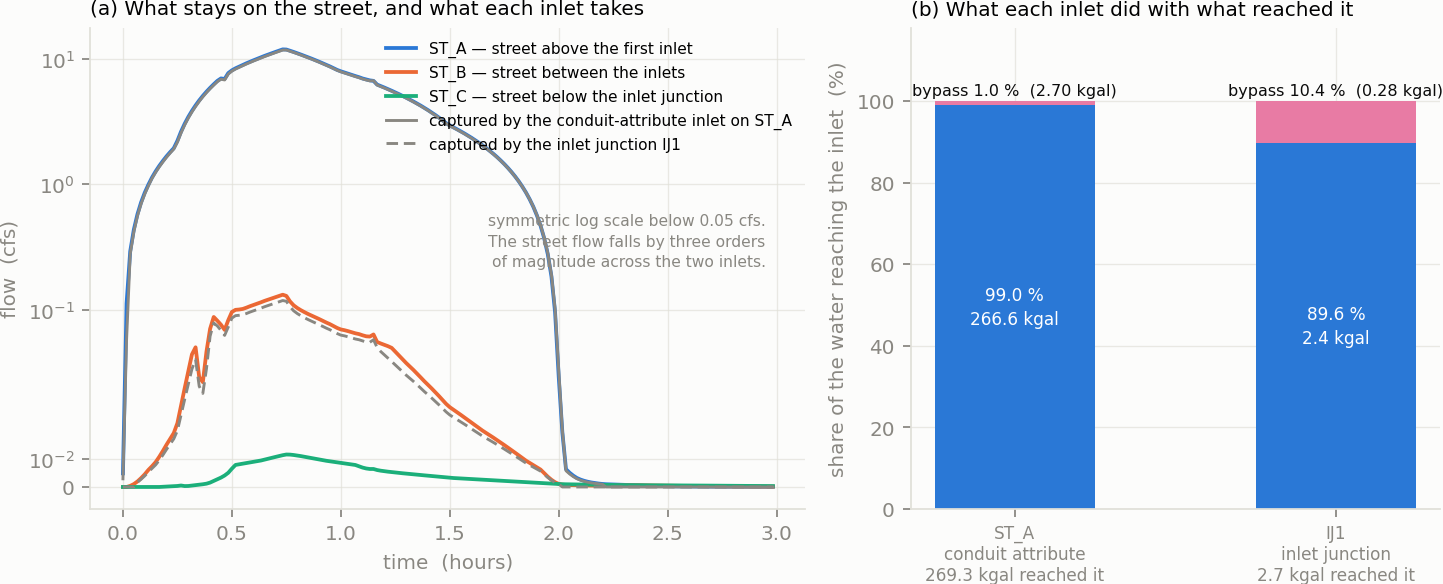
Figure 5-1 Capture and bypass along a street reach with a conduit-attribute inlet and an inlet junction
| Peak approach flow | Peak capture | Average capture | Volume captured | Volume bypassed | |
|---|---|---|---|---|---|
ST_A, conduit attribute | 11.937 cfs | 99.00 % | 98.22 % | 266.6 kgal | 2.70 kgal |
IJ1, inlet junction | 0.133 cfs | 90.00 % | 90.00 % | 2.41 kgal | 0.28 kgal |
Table 5-1 The Street Inlet Flow Summary for the two inlets, as the report prints it
Read the summary's columns carefully. "Peak Flow" is the peak approach flow the inlet saw, not the flow it captured. "Bypass Flow
Pcnt" — 88.90 % for ST_A — is the frequency of bypass over the periods with capture, not a share of the volume; the volume share is the last two columns, and by volume ST_A captured 99 % of what reached it. A reader who takes the bypass column as a volume fraction will conclude the opposite of what the run says.
The first inlet does nearly all the work. It sees 269 kgal over the storm and passes 2.7 kgal on. The inlet junction then sees only what got past the first one, captures 90 % of that, and leaves 0.28 kgal to reach the downstream outfall. Panel (a) shows the same thing as flows: the street flow falls from 11.9 cfs to 0.13 cfs to 0.012 cfs across the two inlets, three orders of magnitude on a symmetric log scale.
What the inlet junction adds. The capture itself is the same HEC-22 calculation either way. The difference is that IJ1 is a node, so it
MH2's surcharge back onto the street as backflow, which a conduit attribute cannot represent at all;ST_B and ST_C rather than terminating them.When the conduit attribute is the right answer. When the inlet is one of a run of many on a long reach, when the sewer below it will not surcharge, and when the street's own hydraulics are not the question. It is cheaper — no extra node, no virtual-junction constraints on the cross-sections — and this run shows it doing the same capture job.
 1.13.2